Books we recommend
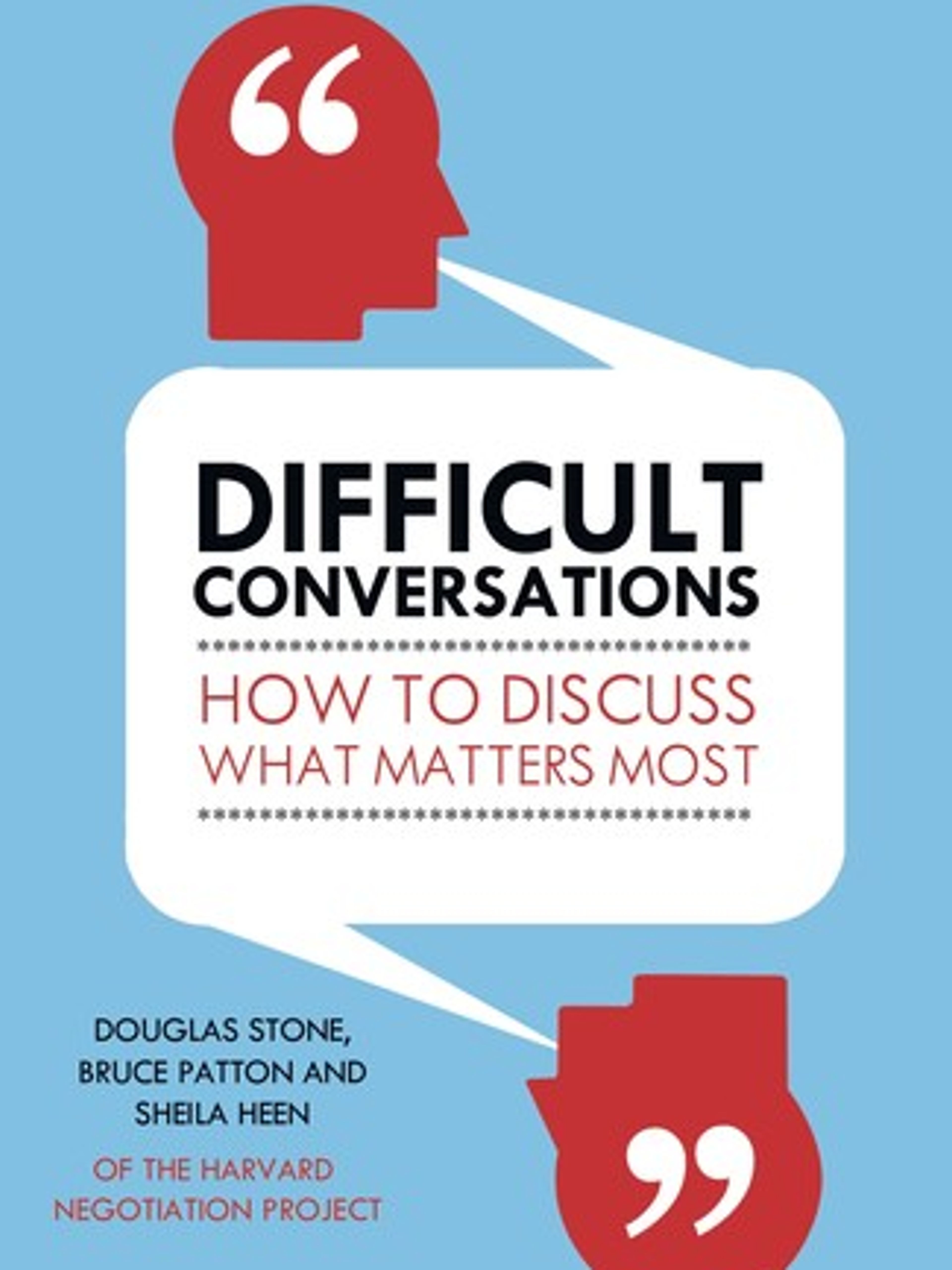
Difficult Conversations: How to Discuss What Matters Most
Douglas Stone, Bruce Patton, Sheila Heen, Roger Drummer Fisher
Published 2011
CommunicationDifficult Conversations
- Difficult conversations are inevitable; avoiding them usually makes problems worse, not better.
- Every hard conversation has three layers: the "What happened?" story, the feelings conversation, and the identity conversation about what this means for who we are.
- Shift from blame to joint contribution: instead of "Who’s at fault?" ask "How did we each contribute to this situation?".
- Replace certainty with curiosity: assume your story is incomplete and actively explore the other person’s perspective.
- Name and validate feelings (yours and theirs) rather than trying to stay purely "rational"—unspoken emotions derail discussions.
- Separate intent from impact: the fact that you were hurt doesn’t prove they meant to hurt you, and good intentions don’t erase negative impact.
- Prepare by clarifying your purpose and what a good outcome would look like—for the relationship as well as the issue.
- Use "and" language instead of "but" to hold multiple truths at once ("I’m frustrated, and I also want us to solve this together").
- Start from a learning stance: open with how you see things, invite their view, and jointly problem-solve rather than trying to win.
- Protect your sense of self by recognizing that criticism usually isn’t about you being all bad or all good; it’s information about impact, not your entire identity.