
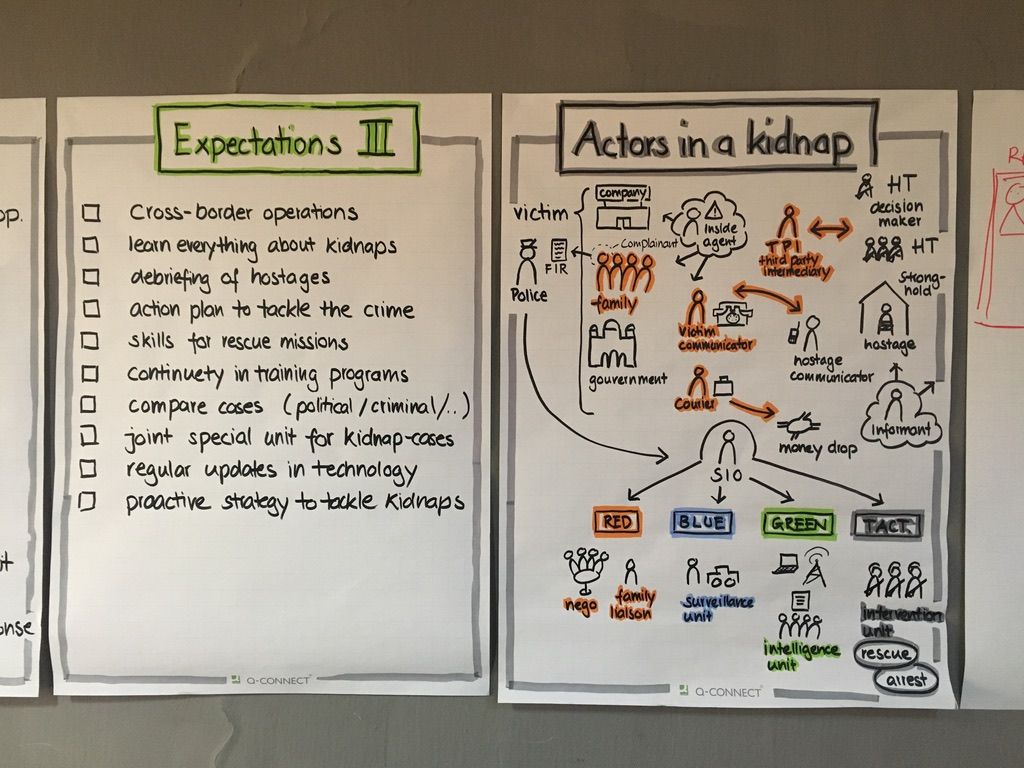
A few months ago I was speaking with Mathias Herter, formerly heading Crisis Management for the Swiss Federal Police, about how crisis teams work the wall—capturing facts, timelines, hypotheses, and options on big, visible surfaces rather than burying them in bullet-point decks. The goal is a living common operating picture (COP): a shared view that aligns everyone on “what’s happening,” “what it means,” and “what we’ll do next.” In emergency doctrine, a COP is a continuously updated overview of an incident across its life cycle so responders make faster, better decisions.
Why walls, not slides? Because spatial, persistent displays let teams connect dots across sources (intel, logs, maps, comms), see gaps at a glance, and coordinate action under pressure. Humanitarian and emergency agencies formalise this with maps, infographics, situation boards and ICS (Incident Command System) forms—physical or digital—so the room literally sees the same story. Evidence from UN OCHA shows such visual IM products (maps, dashboards, sitreps) materially improve situational awareness for partners and donors; ICS guidance likewise standardises wall charts and status boards for multi-agency response.
This visual approach also supports long, complex operations (e.g., extended negotiations): persistent boards capture threads over months, help brief rotating teams, and reduce loss of context. While negotiation tradecraft emphasises skills like active listening to “buy time” and de-escalate, a robust visual picture helps the wider command team track commitments, decision logs, and contingencies without relying on memory.
Where Bikablo Fits
Bikablo is a structured visual facilitation method that teaches teams to translate complex information into clear icons, containers, connectors, and layouts that anyone can grasp at a glance—even under stress. It’s widely used in change, strategy, and transformation work, and its discipline (legible lettering, consistent symbols, left-to-right flows, swimlanes, canvases) maps cleanly onto crisis needs: fast comprehension, shared mental models, and durable visual memory.
Typical Bikablo moves that help crisis teams:
- Canvases & lanes to structure the COP (facts → analysis → options → decisions).
- Icon libraries for recurring entities (assets, risks, stakeholders, locations) so updates are instant and legible.
- Connectors & callouts to show causality, assumptions, and information gaps.
- Map overlays and storyboard timelines to stabilise the narrative as events evolve.
For non-designers, this is accessible and learnable; it’s about clarity, not art—a reason many organisations adopt Bikablo for facilitation and graphic recording.